 How-to
Residential Flooring Installation Services Near Me Explained
Last Updated: November 14, 2026
Quick Summary
Residential flooring installation services near me should cover four phases: in-home measurement and material selection, subfloor inspection and moisture testing, a written quote with itemized labor and materials, and a scheduled installation with cleanup. Skip any one of those and the risk shifts onto you.
- Match each material to the room: carpet for bedrooms, tile for bathrooms and kitchens, luxury vinyl plank for pet-heavy homes.
- A flooring installation quote should itemize materials, labor, floor prep, old floor removal, and trim.
- Rigid materials like luxury vinyl plank and laminate often acclimate for 24 to 48 hours before installation.
- Confirm in writing what a quote excludes, since a bid far below the others usually leaves something out.
- Ask whether the crew is employees or subcontractors and request a recent local customer reference.
Table of Contents
- What Residential Flooring Installation Services Near Me Should Include
- Matching Flooring Materials to Each Room and Household
- Vinyl Flooring Installation Near Me: The Coastal Humidity Choice
- What Residential Flooring Installation Cost Really Depends On
- How to Read a Flooring Installation Quote Line by Line
- Finding Flooring Installation Near Me Without Getting Burned
- Installation Day: Timelines, Prep Steps, and What to Expect
- Book Your Free In-Home Flooring Estimate
- Frequently Asked Questions
What Residential Flooring Installation Services Near Me Should Include
Residential flooring installation services near me is a search that returns a long list of names and very little detail about what each one actually does. That gap matters, because the difference between a smooth project and a nightmare usually sits in the steps a contractor skips. A thorough project is built around the parts most homeowners never see: measuring the actual rooms, testing the subfloor, and matching material to how a household really lives.
A complete service should cover four phases: in-home measurement and material selection, subfloor inspection and moisture testing, a written quote with itemized labor and materials, and a scheduled installation with cleanup. Skip any one of those and the risk shifts onto you.

In-Home Measurement and Material Selection
Samples can look different under showroom lighting than they do in your home. An in-home consultation helps by putting the product where it will live.
For a closer look at why in-home consultations can help, see 7 reasons in-home flooring consultations beat showroom visits.
Subfloor Inspection and Moisture Testing
Subfloor condition decides how long a floor lasts. A contractor should check the subfloor for condition issues before materials are chosen. In coastal homes, humidity and salt air can affect a floor from below as much as above.
Matching Flooring Materials to Each Room and Household
No single material wins everywhere, and any installer who says otherwise is selling what they stock. Match the floor to the room's traffic, moisture exposure, and the people and pets using it.
Carpet, Hardwood, Laminate, and Tile: Where Each One Fits
- Carpet installation: bedrooms, stairs, and any room where warmth and sound absorption matter.
- Hardwood flooring: living and dining areas where resale value and refinishing matter. Solid wood dislikes standing moisture, so keep it out of bathrooms and laundry rooms.
- Laminate flooring: busy family rooms on a budget. It handles scratches well but swells if water sits on the seams.
- Tile flooring: bathrooms, kitchens, and entryways. It shrugs off water but feels cold underfoot and is unforgiving if something heavy drops.
| Room | Best Material | Why |
|---|---|---|
| Bedrooms | Carpet | Warmth, quiet, comfort |
| Living areas | Hardwood or luxury vinyl plank | Resale value, durability |
| Kitchen | Tile or luxury vinyl plank | Water resistance, easy cleanup |
| Bathrooms | Tile | Handles standing water |
| Pet-heavy homes | Luxury vinyl plank | Scratch and accident resistance |
Vinyl Flooring Installation Near Me: The Coastal Humidity Choice
Humidity is a major concern in coastal homes, and luxury vinyl plank is often considered for damp conditions.
The catch is that "waterproof" on a label does not mean watertight at the seams. Installation quality decides whether moisture stays on top of the floor or finds its way underneath. Our guide to flooring for humid coastal homes covers the material comparisons in more depth.
What Residential Flooring Installation Cost Really Depends On
Residential flooring installation cost depends on square footage, material choice, and site conditions. Two homes of the same size can land far apart once subfloor repair, furniture moving, stair work, and trim are factored in.
The honest answer is that pricing depends on your specific rooms, and any quote given before an on-site measure is a guess. For a detailed breakdown of vinyl plank costs in particular, read our guide to the cost of luxury vinyl plank flooring installation.
Watch out: a quote that comes in far below the others usually means something was left out, not that you found a bargain.
How to Read a Flooring Installation Quote Line by Line
A flooring installation quote should itemize five things: materials with quantities, installation labor, floor preparation, removal and disposal of the old floor, and trim or baseboards. If any of those is missing, ask where it appears. The real skill is comparing two quotes on the same scope, because the line items that get left out are usually the ones that cost the most later.
Use this checklist before you sign anything with any installer:
- Square footage listed per room, not just a total
- Material name, brand, and color code specified
- Subfloor prep and repair listed as a separate line
- Old flooring removal and haul-away included
- Baseboards, transitions, and shoe molding accounted for
- Furniture moving spelled out
- Payment schedule tied to milestones, not all up front
- Warranty terms for both product and workmanship in writing
Beyond the checklist, compare these five cost drivers side by side:
- Labor basis. Some quotes price per square foot, others by the hour or by the job. Confirm whether the quote covers stair work, closets, and small rooms.
- Material allowances. A quote that lists a material allowance rather than a specific product lets the contractor substitute a cheaper grade. Ask for the exact product and quantity so you can price it yourself.
- Removal and disposal. Tearing out tile or glued-down hardwood costs more than pulling up carpet, and dumpster fees vary. Confirm whether disposal is included or billed separately.
- Transitions and trim. Thresholds, stair nosings, and baseboard reinstallation are frequently excluded. On a whole-home job these can add meaningful cost.
- Warranty split. Product warranties and workmanship warranties may come from different parties. Confirm what each covers in writing.
Compare quotes on the same scope. A cheap bid with three exclusions is often the most expensive option once the extras get added back in.
Watch out: a quote that comes in far below the others usually means something was left out, not that you found a bargain. Ask each contractor to confirm in writing what is excluded before you compare totals.
Finding Flooring Installation Near Me Without Getting Burned
Flooring installation near me results are dominated by directories and big-box listings, and those are fine starting points, not final answers. What separates a good hire from a bad one is verification: a state contractor license where required, liability insurance, and a workmanship warranty you can read.
Ask three questions before you commit. Who is actually on the crew, employees or subcontractors? What happens if something goes wrong mid-project? And can you speak to a recent local customer? A contractor who disappears halfway through a job usually showed warning signs early: no written contract, a large deposit request, or vague answers about insurance.
Weighing a local contractor against a store-based service? Our comparison of a flooring contractor vs big box store walks through the trade-offs.
Installation Day: Timelines, Prep Steps, and What to Expect
Timelines depend on the project's size, material, and subfloor work, so ask your installer for a schedule specific to your home. The prep you do beforehand speeds everything up, and knowing the sequence removes most of the day-of surprises.
A typical installation moves through six phases:
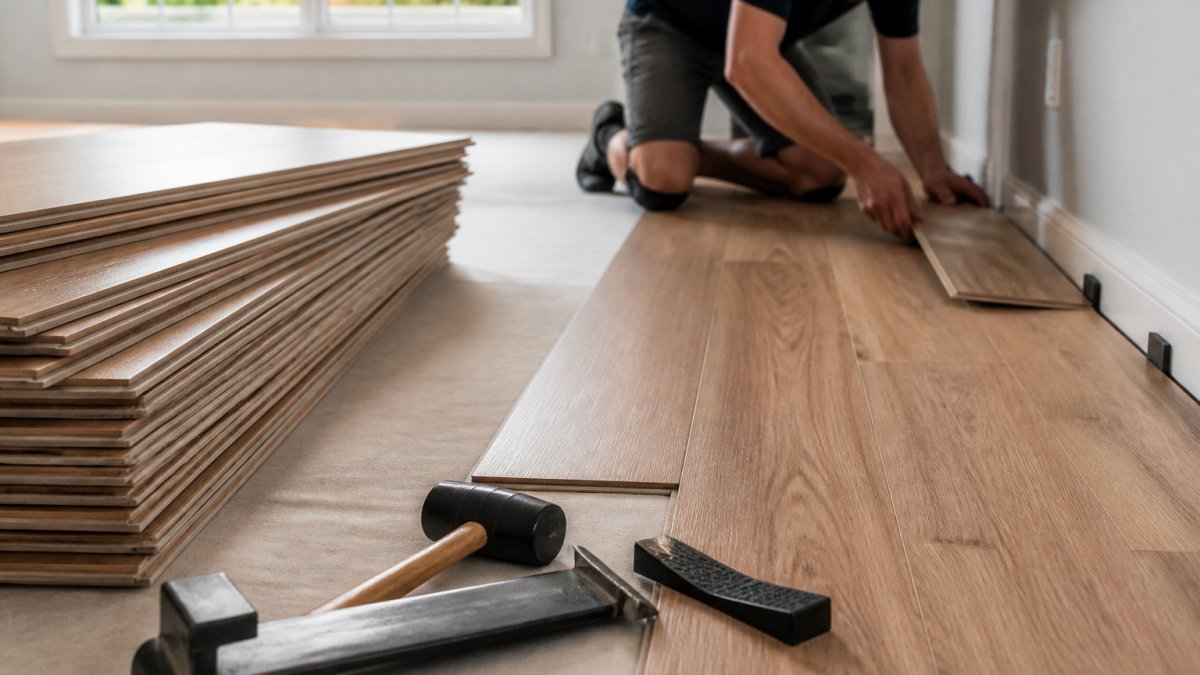
- Final measurement and material delivery. The crew confirms room dimensions against the order, stages boxes in a garage or hallway, and lets rigid materials like luxury vinyl plank and laminate acclimate for the period the manufacturer specifies, often 24 to 48 hours. Carpet and tile usually skip acclimation.
- Furniture and appliance moving. Crews move large items, disconnect and reset appliances such as washers and refrigerators, and pull wall hangings near the work area. Clear small items, decor, and closet contents yourself before the crew arrives.
- Removal and disposal. Old carpet, padding, tile, or hardwood comes up, along with tack strips and staples. Ask in advance where the debris goes and whether haul-away is included in the quote.
- Subfloor preparation. The crew sweeps, patches low spots, grinds high spots, and checks moisture again before any material goes down. This is the step that most affects how the finished floor wears.
- Installation. Planks and tile are cut and fitted room by room, transitions and thresholds are set, and baseboards or shoe molding go back on. Adhesive-set tile and some vinyl require curing time before heavy traffic.
- Walkthrough and cleanup. The crew walks you through seams, transitions, and edges, removes protective coverings, and leaves written care instructions.
Plan for pets and kids to be elsewhere during demolition and adhesive work, and expect some rooms to be unusable for 24 hours or longer while materials cure. Ask the contractor before signing how long each room will be off-limits and whether furniture goes back in place at the end.
Professional installation earns its cost in the details: straight seams, tight transitions, and a floor that still looks right after a few humid summers. Our case for professional flooring installation explains why.
Book Your Free In-Home Flooring Estimate
The hardest part of this process is not picking a color. It is trusting that the crew will show up, do the prep work, and stand behind the result. At Floor Coverings International of Myrtle Beach, we offer a wide range of premium flooring and carpet options and in-home consultations.
Get started with Floor Coverings International of Myrtle Beach and request a free estimate.
Frequently Asked Questions
How much should I pay for residential flooring installation?
There is no single number, because residential flooring installation cost depends on the material you choose, the square footage, how much floor preparation the subfloor needs, and whether old flooring has to come up first. Carpet, luxury vinyl plank, laminate, tile, and hardwood all carry different labor demands, and furniture moving or baseboard work adds to the scope. Ask for a written quote that separates materials from installation labor so you can see exactly what drives the total.
What should a flooring installation quote include?
A complete flooring installation quote should list the material by name and quantity, the installation labor, tear-out and disposal of the old floor, subfloor repair or leveling, moisture testing, furniture moving, and baseboard or trim removal and reinstallation. It should also state the project timeline, payment schedule, and warranty terms for both product and workmanship. If a line item is missing, ask about it before signing, because exclusions are where budgets quietly grow.
Do flooring installers move furniture and remove old flooring?
Many installers do, but not all include it in the base price. Furniture moving, appliance disconnection, carpet removal, and haul-away are often quoted as separate line items. Confirm in writing what your installer includes. Clearing small items yourself before installation day speeds the job up and can reduce the labor charge.
How long does residential flooring installation take?
Timelines vary by material and square footage, and floor preparation and cure times can affect the schedule. Ask your installer for an estimated timeline for your home. A written schedule from your installer should name the start date, the daily work hours, and the expected completion date.