 ultimate-guide
Flooring for Humid Coastal Homes: 2026 Guide
Table of Contents
- What Makes Coastal Homes Hard on Floors
- Quick Comparison: Best Flooring for Humid Climates
- Porcelain and Tile Flooring for Humid Climates
- Luxury Vinyl Plank for Coastal Homes
- Hardwood Flooring in Humid Climates: Engineered vs. Solid
- Installation Details for Coastal Humidity
- Managing Indoor Humidity and Ventilation
- Room-by-Room Recommendations and What to Avoid
- Frequently Asked Questions
Last Updated: October 14, 2026
What Makes Coastal Homes Hard on Floors
Coastal homes punish flooring in ways inland houses never experience. Humidity, salt air, and tracked-in sand work on floors daily, and the wrong material will cup, warp, or stain within a season.
At Floor Coverings International of Myrtle Beach, we see this pattern constantly: a homeowner installs solid hardwood because it looks beautiful, then watches gaps open between boards by the second summer.
Humidity, Salt Air, and Sand: The Three Daily Stressors
Humidity is the first stressor. Coastal air carries far more moisture than inland air, and beach-house humidity routinely climbs in summer.
Salt air is the second. Airborne salt settles on surfaces and works into seams, accelerating fastener corrosion and dulling finishes.
Sand is the third, and the most underestimated.
The Difference Between Humidity Resistance and Flood Performance
These terms get used interchangeably, and that's a costly mistake. Humidity resistance describes how a floor handles airborne moisture vapor over months and years. Flood performance describes what happens when standing water sits on the floor for hours or days.
No flooring is truly flood-proof. Materials marketed as waterproof resist surface water for a limited window, but storm surge and prolonged flooding can still destroy them through the subfloor beneath.
Quick Comparison: Best Flooring for Humid Climates
The table below summarizes how the main options perform against coastal conditions.
| Material | Moisture Resistance | Sand/Scratch Durability | Best Rooms | Main Drawback |
|---|---|---|---|---|
| Porcelain tile | Excellent | Excellent | Baths, kitchens, living areas | Hard and cold underfoot |
| Luxury vinyl plank | Excellent | Very good | Whole home, including basements | Can fade in direct sun |
| Engineered hardwood | Good | Moderate | Bedrooms, living rooms | Limited refinishing |
| Solid hardwood | Poor | Moderate | Rarely suitable | Warps and cups |
| Natural stone | Good to excellent | Varies by stone | Entryways, baths | Needs sealing |
| Laminate | Fair | Good | Low-moisture rooms | Swells if water penetrates |
| Carpet | Poor in wet areas | Fair | Bedrooms only | Traps moisture and sand |
Porcelain and Tile Flooring for Humid Climates
Tile flooring for humid climates is the most reliable choice available. Porcelain is dense, fired at high temperatures, and absorbs almost no water, so airborne humidity has nothing to act on.
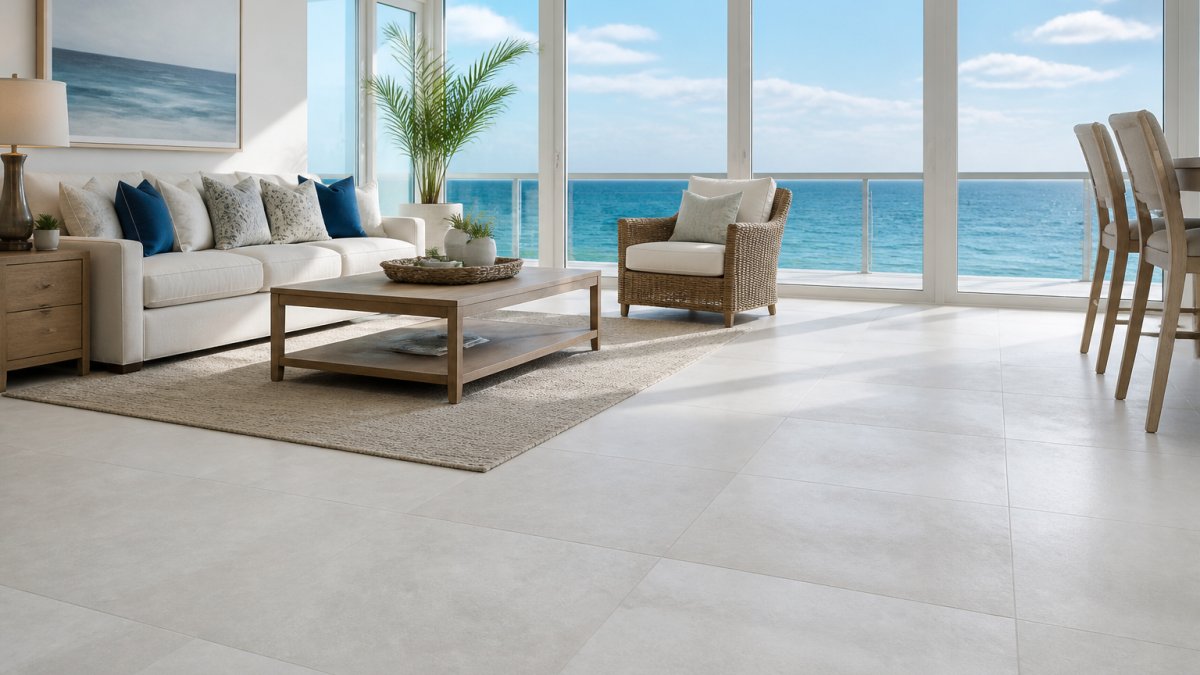
That density also handles sand well: unlike wood or vinyl, porcelain won't scratch from beach grit or swell at the seams.
Porcelain vs. Ceramic: Which Handles Moisture Better
Porcelain wins on moisture. Both are clay-based, but porcelain is fired denser and absorbs far less water than standard ceramic, which matters in beach-house bathrooms, laundry rooms, and any space over a concrete slab.
Ceramic still works in low-traffic, low-moisture rooms and usually costs less, but falls short where humidity or temperature swings are constant, since its more porous body is likelier to crack.
Natural Stone: Slate, Travertine, and Limestone
Natural stone brings the seaside look many coastal homeowners want, but each stone behaves differently. Slate is the toughest, dense, water-resistant, and a strong fit for entryways and mudrooms. Travertine looks warmer but is more porous and needs sealing. Limestone is similar: beautiful, but stains easily and needs regular resealing in humid conditions.
Luxury Vinyl Plank for Coastal Homes
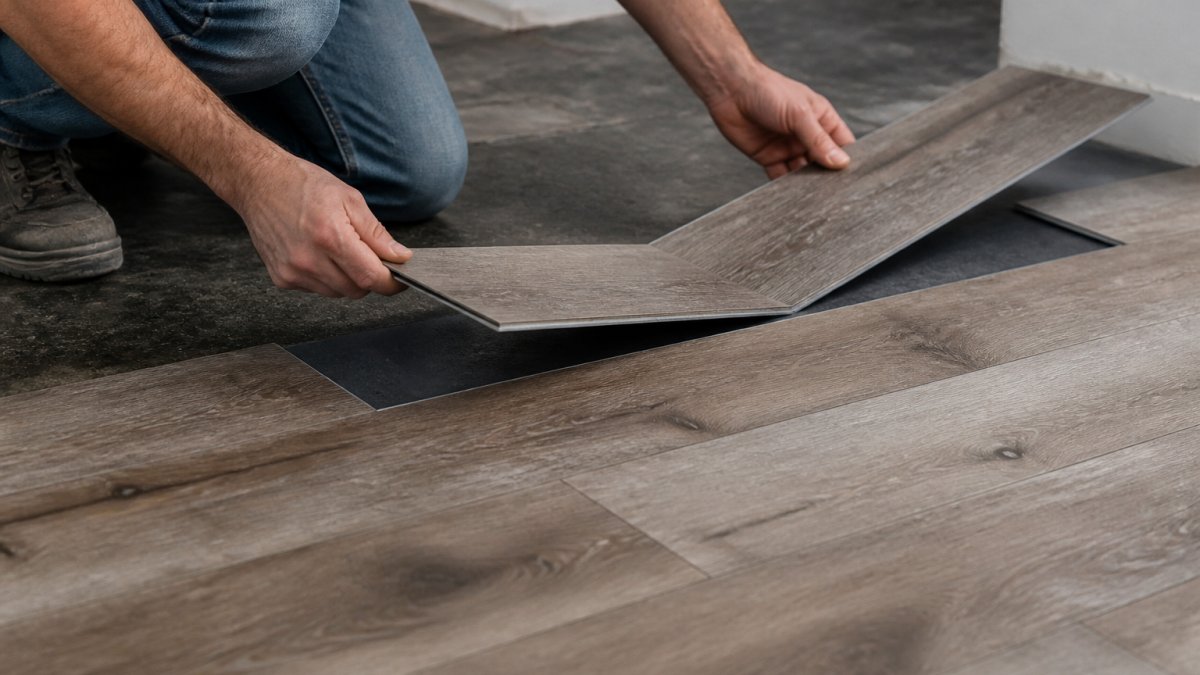
Luxury vinyl plank for coastal homes has become the default recommendation for good reason.
What most guides miss: "waterproof" refers to the plank itself, not the installation.
The honest drawback: prolonged direct sunlight can fade or warp lower-quality LVP, a real concern in rooms with west-facing sliding glass doors.
Hardwood Flooring in Humid Climates: Engineered vs. Solid
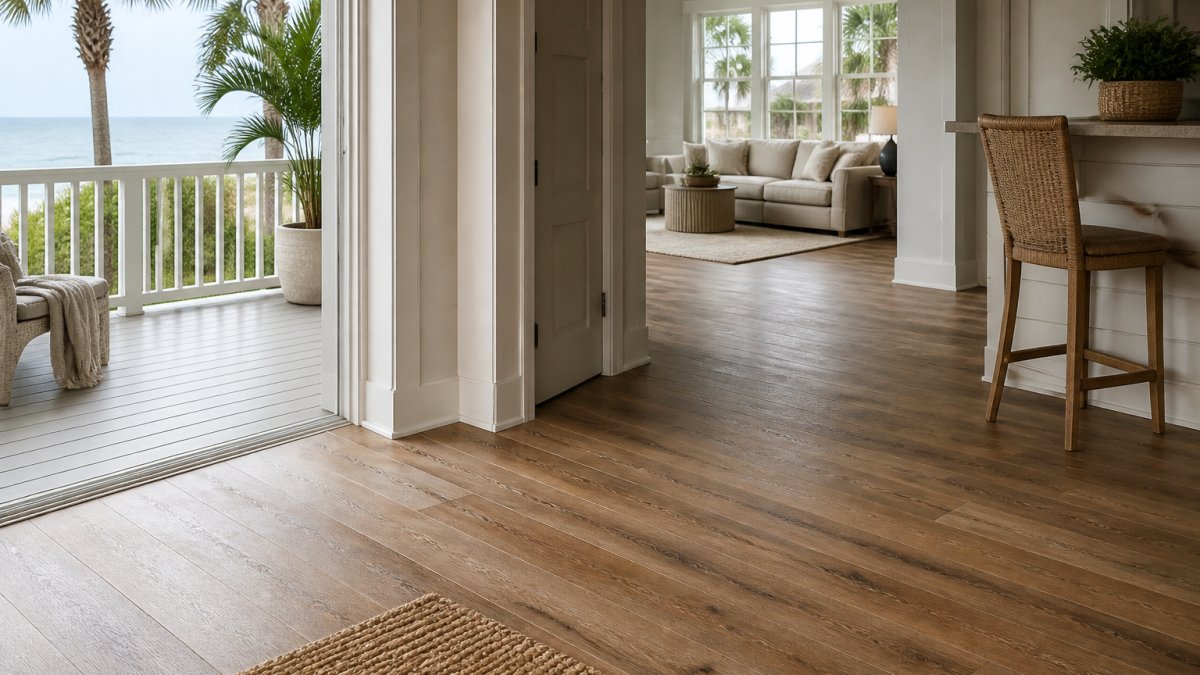
Hardwood flooring in humid climates comes down to one question: engineered or solid? Engineered hardwood has a plywood core and a real wood veneer on top; that cross-layered core resists the expansion and contraction that ruins solid planks, making it far more stable in coastal humidity. Solid hardwood is milled from a single piece of wood, beautiful and refinishable, but in a beach house it will cup, gap, and warp.
Species matters too. White oak is a common pick for its density, tight grain, and resistance to moisture movement compared with softer woods. For wood in a coastal home, engineered white oak is the sensible compromise.
Installation Details for Coastal Humidity
Most flooring failures in coastal homes trace back to installation, not the material. A porcelain tile or LVP floor that would last decades inland can cup, gap, or delaminate within two summers if subfloor, acclimation, and moisture-control steps are skipped.
Test the Subfloor Before Anything Else
Concrete slabs and crawlspace subfloors release moisture vapor continuously, and coastal slabs release more in summer than winter. Two tests are standard:
- Calcium chloride test: A dish of calcium chloride is sealed under plastic on the slab for 60 to 72 hours. The weight gained tells you the moisture vapor emission rate. Most flooring manufacturers set a ceiling around 3 to 5 pounds per 1,000 square feet per 24 hours for wood and LVP; anything above that needs a mitigation system before installation.
- In-situ relative humidity probe: A hole is drilled into the slab, a probe is inserted, and the reading is taken after the sensor equilibrates (often 24 hours or more). Many manufacturers require readings below 75 to 80 percent relative humidity in the slab.
For wood subfloors over a crawlspace, a pin-type moisture meter reading of roughly 12 percent or lower is a common threshold, and the wood should be within a few points of the flooring being installed. A crawlspace vapor barrier and proper ventilation are prerequisites, not upgrades.
Acclimate to the Home, Not the Warehouse
Acclimation means letting the flooring sit in the room where it will be installed long enough to reach equilibrium with that room's temperature and humidity.
A practical check: measure the moisture content of the flooring and the subfloor before installation. If they are more than a few points apart, wait.
Expansion Gaps and Transitions
Humid air makes wood and some composite cores swell. Every floor that can move needs room:
- Leave a gap of roughly 1/4 to 3/8 inch at every wall, cabinet, column, and fixed object for wood and LVP.
- Use transition strips at doorways and where flooring changes.
- Do not caulk or grout the perimeter gap tight, it defeats the purpose.
Porcelain tile behaves differently: it doesn't expand with humidity like wood, but still needs movement joints (often every 20 to 25 feet in large open areas) to accommodate thermal movement and prevent tenting.
Underlayments and Vapor Barriers
Underlayment choice depends on the material and the subfloor:
- Over concrete: A vapor barrier or moisture-mitigating membrane is standard for LVP and engineered wood. Some LVP products have an attached pad; check whether the manufacturer still requires a separate vapor barrier.
- Over wood subfloor: A felt or foam underlayment is common for LVP, while engineered hardwood may be glued, floated, or stapled depending on the product.
- Tile: An uncoupling membrane (a common example is a polyethylene membrane with a grid of channels) isolates the tile from subfloor movement and is widely used over concrete slabs in coastal homes.
Salt Air and Fasteners
Airborne salt accelerates corrosion of metal fasteners, staples, and nails. Stainless-steel or hot-dip galvanized fasteners cost more but last far longer in coastal installations. The same logic applies to metal transition strips and ventilation grilles.
A Note on Timing
Schedule installation when the home is conditioned and the weather isn't at its most extreme. Installing mid-summer without AC is a common cause of early failure. If the home will sit empty afterward, keep the HVAC at a moderate setting so the floor doesn't hit a humidity spike.
Managing Indoor Humidity and Ventilation
The best floor can't outrun a house with uncontrolled indoor humidity. Keep relative humidity stable with air conditioning, dehumidifiers, and exhaust fans in bathrooms and kitchens.
Ventilation matters on both sides: exhaust humid air out and let conditioned air circulate. Ceiling fans and open interior doors help, but mechanical dehumidification is what holds humidity steady during the wettest months.
Room-by-Room Recommendations and What to Avoid
No single floor is right for every room in a coastal home. Exposure to water, sand, salt, and foot traffic varies dramatically from entryway to bedroom, and matching material to room keeps a floor performing for its full lifespan.
Entryways and Mudrooms
Best choice: Porcelain tile or slate.
Entryways take the brunt of tracked-in sand, salt, and water. Porcelain tile handles all three without scratching, staining, or swelling, and slate adds a natural, textured look that hides grit well.
A quality walk-off mat and a shoe-removal habit reduce the abrasive load on every floor beyond the entry.
Kitchens and Bathrooms
Best choice: Porcelain tile.
These are the highest-moisture rooms in the house, with spills, steam, and frequent mopping. Porcelain's near-zero water absorption makes it the safest pick. Grout is the weak point, use epoxy-based grout, seal it, and clean regularly to prevent mildew. Tile here lasts decades and can be repaired tile-by-tile.
Living Areas and Open-Plan Spaces
Best choice: LVP or engineered hardwood.
Living areas need warmth and coastal style without sacrificing durability. LVP is dimensionally stable, handles humidity swings well, and stands up to sand better than most wood floors. Engineered hardwood offers real wood appearance with a cross-layered core that resists the expansion and contraction that ruins solid planks.
Bedrooms
Best choice: Carpet or engineered hardwood.
Bedrooms see less water and sand than the rest of the house, so comfort matters more. Carpet adds warmth underfoot but must stay dry, a bedroom with an ensuite bath or leak-prone window is a poor fit. Engineered hardwood is the safer bet in humid coastal bedrooms and handles seasonal humidity swings without gapping.
Basements and Lower Levels
Best choice: LVP only.
Lower levels carry the highest moisture risk because ground moisture and humid air both migrate downward. LVP with a waterproof core is the standard recommendation, and even then a vapor barrier and subfloor moisture test are essential. Avoid carpet, solid wood, and standard laminate here.
What to Avoid Anywhere Prone to Dampness
- Solid hardwood: Cups, gaps, and warps in coastal humidity; refinishing does not fix a moisture-damaged board.
- Standard laminate: Swells permanently if water penetrates the seams; the swelling does not reverse when the floor dries.
- Wall-to-wall carpet in wet areas: Traps moisture and sand, promotes mildew, and is difficult to dry after a leak or flood.
A Note on Cost and Lifespan
Installed costs vary widely by region, product line, and subfloor condition, but the pattern holds: porcelain tile and natural stone cost more upfront and last longer, while LVP and engineered hardwood cost less upfront and may need replacement sooner. Carpet is cheapest upfront but shortest-lived in a humid coastal home.
Frequently Asked Questions
What is the best flooring for a hot, humid climate?
Porcelain tile and luxury vinyl plank (LVP) are the two most reliable choices. Porcelain is nearly waterproof and handles high humidity without warping, cupping, or swelling. LVP is also water-resistant and comfortable underfoot. Engineered hardwood can work if you manage indoor humidity carefully, but solid hardwood is risky in a hot, humid climate because it expands and contracts with moisture.
Can humidity damage hardwood flooring?
Yes. Solid hardwood absorbs moisture from the air, which causes boards to swell, cup, and warp over time. Engineered hardwood is more stable because its plywood core resists moisture movement, but it still needs indoor humidity kept between 35% and 55%. In a coastal home, run a dehumidifier or air conditioning consistently to protect any wood floor.
Is luxury vinyl plank a good choice for humid coastal homes?
LVP is one of the best options for coastal homes. It is water-resistant, handles high humidity without swelling, and stands up to sand and foot traffic. Look for a thick wear layer (20 mil or more) and a rigid core for stability. LVP also handles temperature changes better than solid wood and is easy to clean after a day at the beach.
How should flooring be installed in a humid coastal home?
Let materials acclimate in the home for at least 48 to 72 hours before installation so they adjust to local humidity. Test the subfloor for moisture and use a moisture barrier where needed. Leave proper expansion gaps at walls for any wood or LVP floor. For tile, use a modified thinset rated for humid conditions. These steps prevent buckling, cupping, and adhesive failure.
What flooring is easiest to maintain in a beach house?
Porcelain tile and LVP are the easiest to maintain. Both handle sand, saltwater, and humidity without special care. Sweep or vacuum regularly to remove abrasive sand, and damp-mop with a pH-neutral cleaner. Avoid waxes or oil soaps that can build up. Tile grout should be sealed periodically to resist staining and moisture.
Is tile flooring a good choice for homes in humid climates?
Yes. Porcelain tile is highly moisture-resistant and will not warp, swell, or grow mold on the tile itself. It stays cool in warm weather, which suits coastal homes. The main caveat is grout, which is porous and can stain or hold moisture if not sealed. Choose a narrow grout line and seal it every one to two years for best results.
Coastal flooring is a long-term decision, and getting it wrong means replacing a floor years before its time. Floor Coverings International of Myrtle Beach brings premium flooring and carpet options to every project, with in-home consultations that match materials to your actual rooms and humidity conditions, plus installation handled by a team focused on doing the job right. Get a Free Estimate and choose flooring built to survive the coast.