 Ultimate guide
The Homeowner's Guide to Moisture Resistant Flooring for Beach Homes
Last Updated: October 28, 2026
Quick Summary
Luxury vinyl plank is the best moisture resistant flooring for most beach homes because it is waterproof through its full thickness and handles sand without complaint. Porcelain tile ranks a close second for its resistance to salt and sand abrasion, especially in entryways, baths, and mudrooms.
- Waterproof refers to the material itself; seams, expansion gaps, and wall junctions depend on installation.
- Use porcelain tile or glue-down LVP in entryways and mudrooms, the highest sand and water exposure areas.
- Keep indoor humidity in the 30-50% range and sweep or vacuum sand at least twice weekly.
- Engineered wood is a more stable alternative to solid hardwood in high-humidity environments.
- Test concrete slabs for moisture vapor emission and address it with a vapor barrier before installation.
Table of Contents
- Why Beach Homes Need Specialized Moisture Resistant Flooring
- Comparison Table: Best Moisture Resistant Flooring Options for Beach Homes
- Is Luxury Vinyl Plank Flooring Waterproof?
- Pros and Cons of Tile vs. Vinyl for Beach Houses
- Engineered Hardwood and Solid Hardwood in Coastal Humidity
- Maintaining Floors in Humid Coastal Climates
- Subfloor Preparation and Installation Details That Prevent Water Damage
- Get a Free Estimate for Your Beach Home Flooring
- Frequently Asked Questions
Why Beach Homes Need Specialized Moisture Resistant Flooring
Salt air, blowing sand, and humidity are factors to consider when choosing flooring for a beach home.
The stakes are higher than cosmetics. The Building America Solution Center resource guide on water-resistant flooring requires water-resistant hard-surface flooring in high-moisture zones such as kitchens, bathrooms, and entryways to prevent structural damage. In a beach house, those zones are everywhere: the mudroom tracking in sand, the bathroom off the deck, the kitchen that opens to the porch.
Moisture resistance and waterproofing are distinct terms. For a broader look at how coastal humidity affects each material, see our guide to flooring for humid coastal homes.
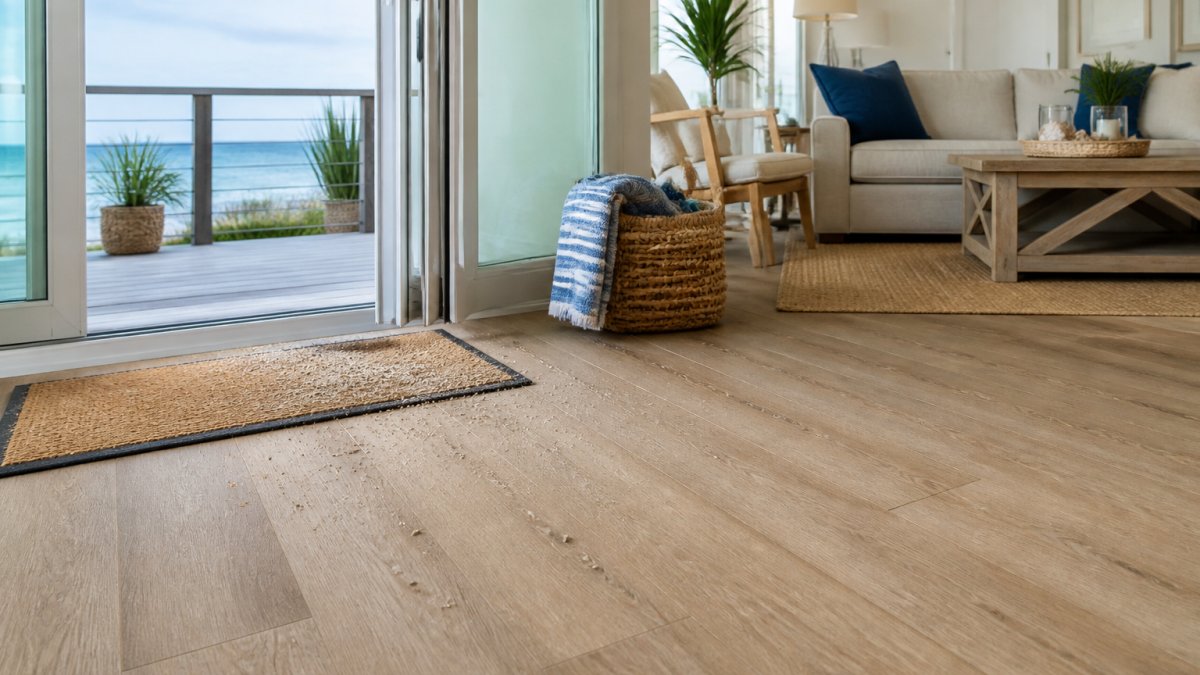
Comparison Table: Best Moisture Resistant Flooring Options for Beach Homes
The table below summarizes the leading options, their water-performance claims, where each one belongs in a coastal home, and the long-term cost picture. Read the notes beneath it before you shop, the difference between a "waterproof" label and real-world protection at seams, edges, and subfloors is where most beach-home flooring decisions go wrong.
| Material | Water Performance | Best Rooms | Watch Out For | Relative Lifecycle Cost |
|---|---|---|---|---|
| Luxury vinyl plank (LVP) | Waterproof core; seams and edges are the weak points | Whole home, including below grade | Can feel thin underfoot; floating installs can trap moisture at perimeter | Low upfront, low maintenance, replace room by room |
| Porcelain tile | Impervious to water when grout and substrate are correct | Entryways, baths, sunrooms, mudrooms | Cold, hard surface; grout lines need sealing in wet zones | Higher upfront, very low maintenance, decades of service |
| Waterproof laminate | Water-resistant core; swells under standing water | Living areas, bedrooms | Seams and edges wick water; not for wet rooms | Low upfront, moderate risk in flood-prone rooms |
| Engineered hardwood | Moisture-tolerant, not waterproof | Bedrooms, dining rooms | Not for wet zones; requires humidity control | Moderate upfront, higher maintenance, refinishable |
| Natural stone | Moisture-resistant when sealed | High-end living spaces | Needs periodic resealing; salt and grit abrade sealer | High upfront, ongoing sealing cost |
What "Waterproof" Actually Means at the Seams
A plank or tile can be waterproof through its core and still fail at the perimeter. Waterproof refers to the material itself; water resistance at seams, expansion gaps, and wall junctions depends on installation. Floating LVP locks together but can let water migrate under the field at the perimeter gap. Glue-down LVP and porcelain tile set in thinset with sealed grout limit that migration. Ask any installer two questions: how are the seams protected, and what happens at the expansion gap when a sliding door is left open in a storm?
Room-by-Room Recommendations
- Entryways and mudrooms: porcelain tile or glue-down LVP, the highest sand and water exposure in the house.
- Kitchens and baths: porcelain tile or LVP with sealed seams; keep engineered hardwood and laminate out.
- Living areas and bedrooms: LVP for rental and family homes; engineered hardwood where real wood grain matters and humidity is controlled.
- Sunrooms and below-grade spaces: SPC rigid-core LVP or porcelain; avoid laminate and solid wood.
Lifecycle Cost, Not Just Sticker Price
Luxury vinyl plank leads for most coastal homes because it is waterproof through its core and handles sand without complaint. Porcelain stoneware ranks a close second: Emilgroup's beach house flooring analysis cites porcelain as a premier coastal material for its resistance to salt and sand abrasion. If you are weighing plank against tile by budget, our breakdown of luxury vinyl plank installation costs covers what drives the number.
Is Luxury Vinyl Plank Flooring Waterproof?
Yes. Luxury vinyl plank flooring is waterproof through its full thickness, not just at the surface, because the core is synthetic rather than wood-based. That construction allows installation at every grade level, including below-grade spaces, according to Carpet One's waterproof flooring guide, and it is why LVP keeps showing up in coastal remodel plans.
SPC vs. WPC: Which Rigid Core Performs Better in Humidity
One caveat worth knowing. Some installers argue that floating floors, including certain SPC products, trap air pockets that perform worse in high humidity than solid-set materials, a concern raised in Houzz discussion forums. Ask your installer how the floor will be acclimated and whether glue-down makes more sense for your rooms.
Pros and Cons of Tile vs. Vinyl for Beach Houses
For a beachfront property where durability is the whole point, porcelain is the safer bet. For a family rental with kids and dogs, vinyl tile delivers most of the look with fewer compromises. The pros and cons of tile versus vinyl for beach houses usually come down to one question: do you want a floor that lasts 30 years, or one you can replace room by room?
Engineered Hardwood and Solid Hardwood in Coastal Humidity
Solid hardwood is the wrong choice for most coastal homes, and engineered wood is the fix. Floors USA's coastal living guide recommends engineered wood as a more stable alternative in high-humidity environments because its cross-ply core resists the expansion that makes solid planks cup and gap.
Maintaining Floors in Humid Coastal Climates
Maintenance in a beach home is not just cleaning, it is managing salt, sun, and temperature swings that inland flooring guides never mention. The routine below covers the basics, then the coastal-specific hazards that determine whether a floor lasts five years or twenty.
The Weekly Routine
- Run the AC or dehumidifier to keep indoor humidity in the 30-50% range
- Sweep or vacuum sand at least twice weekly; grit acts like sandpaper on any finish
- Wipe spills within minutes, especially on laminate and engineered wood
- Use doormats at every exterior door and a mudroom tray for wet shoes
- Place area rugs in high-traffic zones to cut wear and trap grit
- Reseal natural stone annually and inspect caulk lines each season
- Keep furniture pads under legs to prevent dents in rigid-core vinyl
Salt Air, UV, and Temperature: The Hazards Inland Guides Skip
Salt air is abrasive and mildly corrosive. It settles on floors as a fine film that, combined with sand, dulls finishes faster than inland dust. UV exposure through sliding doors and large windows fades finishes and can yellow some vinyl wear layers over time; area rugs rotated seasonally help even out fading. Coastal temperature swings, hot days, cool nights, strong AC, drive expansion and contraction. That is why expansion gaps at walls matter more here than inland, and why floating floors can develop perimeter gaps if the gap is too tight. Our guide on how to prevent flooring buckling in humidity walks through the steps to protect your new floors. Metal transition strips and fasteners near doors are the first places to show corrosion; inspect them each season.
After a Storm: What Can Be Saved
Storm surge and wind-driven rain raise a different question: which floors can be dried and cleaned, and which must be replaced?
Subfloor Preparation and Installation Details That Prevent Water Damage
Most flooring failures in beach homes trace back to the subfloor, not the product. If you are deciding who should handle the work, see our comparison of a flooring contractor vs a big box store. A flat, dry, clean substrate determines whether planks lock tight and stay that way through a humid summer.
Key steps before any installation:
- Test concrete slabs for moisture vapor emission and address it with a vapor barrier
- Check plywood subfloor moisture content and acclimate flooring in the home for the manufacturer's specified period
- Level low spots with patching compound; rigid-core vinyl tolerates minor variation but not dips
- Leave expansion gaps at walls so planks can move with temperature swings
- Seal penetrations around plumbing and HVAC boots
Get a Free Estimate for Your Beach Home Flooring
Floor Coverings International of Myrtle Beach provides premium flooring and carpet options designed to enhance the beauty and functionality of your space. Our wide range of options is tailored to meet your specific needs.
Get started with Floor Coverings International of Myrtle Beach and schedule your free estimate.
Frequently Asked Questions
Is luxury vinyl plank flooring waterproof?
Luxury vinyl plank is one flooring option to consider for a beach home. Floor Coverings International of Myrtle Beach offers a wide range of premium flooring and carpet options tailored to your needs.
What is the best flooring for a house near the ocean?
The right flooring choice depends on your needs. Floor Coverings International of Myrtle Beach offers a wide range of premium flooring and carpet options tailored to your specific needs.
Does humidity affect hardwood floors in beach homes?
Floor Coverings International of Myrtle Beach offers a wide range of premium flooring and carpet options tailored to your specific needs.
How do you protect floors from sand and salt damage?
Floor Coverings International of Myrtle Beach offers a wide range of premium flooring and carpet options tailored to your specific needs.
Is tile or vinyl better for a beach house?
Floor Coverings International of Myrtle Beach offers a wide range of premium flooring and carpet options tailored to your specific needs.
The coast is unforgiving to the wrong floor, but the right material plus a careful install will outlast the mortgage. If you are tired of watching seams lift and planks cup, let us put a specification together for your home. Get started with Floor Coverings International of Myrtle Beach and get a free estimate on flooring that stands up to salt air, sand, and summer humidity.